 |
“30th SUNDAY” in Ordinary Time (Cycle A)
|
Quick Links: |
October 25, 2026
Exodus 22:20-26;
1 Thessalonians 1:5c-10;
Psalm 18:2-3, 3-4, 47, 51;
Matthew 22:34-40
By: Fr. Jude Siciliano, OP
Dear Preachers:
The Pharisees show up frequently in the Gospels, don't they? Usually, they are portrayed as opponents of Jesus, sometimes violently so. Yet some Pharisees were sympathetic to Jesus. Paul was once a Pharisee, as was Nicodemus, who came to Jesus by night.
There were approximately 6,000 Pharisees in Jesus' time. The name Pharisee is generally understood to mean “separated ones.” They sought to distinguish themselves through their observance of the Law and the traditions of their ancestors. Some looked down on ordinary people, whom they considered insufficiently observant of the Law. These people were sometimes referred to as the “people of the land.”
The Pharisees were primarily laypeople, although some priests may also have belonged to the movement. They zealously sought to preserve the teachings of the Law and the traditions of their ancestors. They strove to protect the integrity of those teachings. To keep people from violating the Law, they developed additional rules and interpretations that served as a kind of “fence” around it.
But how could an ordinary shepherd, housekeeper, or butcher possibly observe all those regulations? A person who wanted to be faithful to God might turn to a Pharisee or rabbi for guidance. Perhaps that helps us understand the question put to Jesus in today's Gospel: “Teacher, which commandment in the law is the greatest?” In other words: “Help me understand God's Law. Sum it up for me.”
According to a traditional saying, a teacher might be asked to summarize the Law while standing on one foot. The answer would have to be brief and to the point.
Jesus recognized the importance of the Pharisees' zeal for the Law. His criticism was directed especially at religious hypocrisy and the tendency of some to look down on ordinary people. Some appeared to believe that their strict observance of the Law put them in especially good standing with God. Matthew tells us that the Pharisees had heard that Jesus had silenced the Sadducees. They approached him with their question: “Teacher, which commandment of the law is the greatest?”
It is almost as if they were saying, “Standing on one foot, Rabbi, can you sum up all God's commands and all the rules and regulations handed down by our teachers?” Jesus responds with a brief and pointed statement: “You shall love the Lord your God with all your heart, with all your soul, and with all your mind.”
In other words, love God with your whole being.
The Pharisees would have recognized this commandment. Jesus was not making it up; he was drawing from Deuteronomy 6:5. It is part of the central Jewish prayer known as the Shema, named after its opening Hebrew word, meaning “Hear.”
Jesus declares this the greatest and first commandment. But he does not stop there. He joins it to a second commandment from Leviticus: the command to love one's neighbor as oneself. He takes these two teachings and brings them together. The message is clear: “Love God with your whole being. Express your love for God by loving your neighbor. You cannot separate one from the other.
Where do we find the Image of God?
Jewish tradition forbids the making of images of God. This distinguished Israel's worship from that of many neighboring peoples, who worshiped their gods through images and statues. Imagine a pagan asking a Jew, “Where is your image of God?” A Jewish response might be: “Look at the human person. We are made in the image of God.” In other words, the image of God is reflected in every human being.
That is the connection we can draw from Jesus' teaching in today's Gospel. How can we, as human beings, pay proper homage to an invisible God? How can we honor God in our world and in our daily lives?
Jesus shows us how. He takes the commandment to love God with our whole being and joins it to the commandment to love our neighbor. In effect, he tells us: “If you want to love the God you cannot see, love the human being you can see.”
Each human person bears the image of God and deserves to be treated with dignity.
A Reminder on Our Doorposts.
Let us return for a moment to the central Jewish teaching Jesus quotes. The Shema includes these words: “You shall love the Lord your God with all your heart, with all your soul, and with all your might.”
In Jewish homes, a small container called a mezuzah is traditionally affixed to the doorpost. It contains a parchment scroll inscribed with passages from the Torah, including the Shema. The scroll is carefully prepared by a trained scribe.
The mezuzah is placed on the doorpost at an angle. Some Jews touch or kiss it as they leave their homes and as they return. We might imagine the prayer accompanying that gesture: “As I leave my home, may I live in the world in a way that reflects my love and devotion to God and God's ways.” and...
As I return home, may I show that same love and devotion in the way I treat my family and all those who enter my home.
Inspired by this Jewish tradition, we might write the commandment Jesus gave the Pharisee on a special piece of paper or card and place it somewhere we will see it as we leave and enter our homes. We might even kiss it as a reminder of Jesus' central teaching:
“You shall love the Lord your God with all your heart, with all your soul, and with all your mind. ...You shall love your neighbor as yourself.”
Just a brief look at the Exodus reading for it is relevance these days. In Exodus, God gives the Israelites a clear command: “You shall not molest or oppress an alien, for you were once aliens yourselves in the land of Egypt.” God reminds the people that they know what it means to be strangers in a foreign land, to live with uncertainty, and to depend on the kindness of others.
This message speaks powerfully to us Christians today as we encounter immigrants seeking safety, work, and a better future for their families. Whatever their country of origin or legal circumstances, immigrants are human beings with dignity, families, hopes, and fears. They are not simply a political issue; they are our brothers and sisters.
The central question is not simply, “Where do these people come from?” but “How are we treating them?” God reminds us that our faith must be visible in the way we treat the vulnerable. When we defend the dignity of immigrants, listen to their stories, and respond to their needs, we put God's command into practice.
The stranger among us may be precisely the person through whom God asks us to demonstrate the love of Christ.
Click here for a link to this Sunday’s readings:
https://bible.usccb.org/bible/readings/102526.cfm
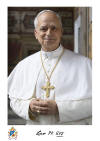
“Every migrant is a person,” and therefore has “inalienable rights that must be respected in every situation.”
---Pope Leo XIV

“You shall not wrong any widow or orphan.”
---Exodus 22:21
I once read that the greatness of a nation rests in how that nation cares for children.
Children are the future and, if they are in peril, so is that future.
Pope Leo writes a beautiful message for last month’s 112th World Day of Migrants & Refugees” titled, “Even Just One of These Children (cf. Mt 18:10).” He writes:
My thoughts turn to the words of Jesus that profoundly challenge our consciences: “Whoever receives one such child in my name receives me” (Mt 18:5). It is not a question of numbers or statistics. The Gospel invites us not to calculate: even one. Every child, every human being, possesses an infinite dignity.
Each is created in the image and likeness of God (cf. Gen 1:26); each is a presence of the Lord.
Before every migrant child, we are called to make an act of humanity and faith, for we are able to welcome and encounter the Lord.
This call becomes even more pressing in the light of another of the Lord’s affirmations in the Gospel of Matthew: “I was a stranger and you welcomed me” (Mt 25:35).
Sadly, migrant children are more easily ignored, because they lack adults capable of protecting and supporting them.
It is necessary, then, to intervene in their countries of origin in order to remove the causes that compel them to flee, while at the same time offering protection and welcome in the countries of transit and destination.
The cry of displaced children rises to God today, just as did the cry heard in the Book of Exodus [Ex 3:7–8] . . .God hears their cry and, in order to bring about liberation, he forcefully appeals to the conscience and action of each one of us, just as he did with Moses.
We cannot remain indifferent, nor can we become accustomed to such suffering.
Message of the Holy Father for the 112th World Day of Migrants and Refugees 2026
Imagine if our nation truly treasured children.
There would have been no child slaves from the inception of our country; no Trail of Tears; no child labor especially during the Industrial Revolution; no child trafficking; and no child who is hungry, homeless, lacking medical care, caught in generational poverty or in jail for fleeing their country of origin. Will we ever be a nation that values the lives of children by restoring the natural world to full health for future generations of children? We cannot remain indifferent.
Barbara Molinari Quinby, MPS, Director
Office of Human Life, Dignity, and Justice Ministries
Holy Name of Jesus Cathedral, Raleigh, NC
Mini-reflections on the Sunday scripture readings designed for persons on the run. “Faith Book” is also brief enough to be posted in the Sunday parish bulletins people take home.
From today’s Gospel reading:
"You shall love the Lord, your God, with all your heart, with all your soul,
and with all your mind.
This is the greatest and the first commandment. The second is like it:
You shall love your neighbor as yourself.
Reflection:
The way we know that we are living Jesus’ commandment of total dedication to God, who is unseen, is to make that love visible by loving our neighbor as self. Jesus’ life shows us whom he considered his neighbor. Besides his disciples and friends, neighbor for Jesus included the least likely, the overlooked, the vulnerable and the people who are usually described in stereotypes.
So, we ask ourselves:
• Is God at my center, the inspiration and impetus behind my thoughts, feelings and actions?
• Who is the surprising neighbor Jesus is calling me to love?
• And how shall I share Jesus’ love with that person (s)?
POSTCARDS TO DEATH-ROW INMATES
“One has to strongly affirm that condemnation to the death penalty is an inhuman measure that humiliates personal dignity, in whatever form it is carried out.”
---Pope Francis
Inmates on death row are the most forgotten people in the prison system. Each week I am posting in this space several inmates’ names and locations. I invite you to write a postcard to one or more of them to let them know that: we have not forgotten them; are praying for them and their families; or whatever personal encouragement you might like to give them. If the inmate responds, you might consider becoming pen pals.
Please write to:
 Tony
Savalis #0395658 (On death row since 3/23/2011)
Tony
Savalis #0395658 (On death row since 3/23/2011)
Mario Mc Neil #0788387 (5/29/2013)
Jonathan Richardson #0788387 (4/4/2014)
Central Prison, PO Box 247, Phoenix MD 21131
(While the prison is in Raleigh mail for inmates is processed at this address)
For more information on the Catholic position on the death penalty go to the Catholic Mobilizing Network: http://catholicsmobilizing.org
“First Impressions” is a service to preachers and those wishing to prepare for Sunday worship. It is sponsored by the Dominican Friars. If you would like “First Impressions” sent weekly to a friend, CLICK HERE.
If you would like to support this ministry, please send tax deductible contributions to:
Fr. Jude Siciliano, OP
Holy Rosary Priory
3600 Travis St.
Houston, TX 77002-9591
Make checks payable to: Dominican Friars.
Or go to our webpage to make a secure online donation:
https://PreacherExchange.com/donations.htm
 Young St. Dominic |
|
 © 1999 - 2027 Dominican Friars. This page last updated 10/24/2026 |


